In the beginning was the Word, and the Word was with God, and the Word was God. He was in the beginning with God. All things came into being through him, and without him not one thing came into being. What has come into being in him was life, and the life was the light of all people. The light shines in the darkness, and the darkness did not overtake it.
There was a man sent from God whose name was John. He came as a witness to testify to the light, so that all might believe through him. He himself was not the light, but he came to testify to the light. The true light, which enlightens everyone, was coming into the world.
He was in the world, and the world came into being through him, yet the world did not know him. He came to what was his own, and his own people did not accept him. But to all who received him, who believed in his name, he gave power to become children of God, who were born, not of blood or of the will of the flesh or of the will of man, but of God.
And the Word became flesh and lived among us, and we have seen his glory, the glory as of a father’s only son, full of grace and truth. (John testified to him and cried out, “This was he of whom I said, ‘He who comes after me ranks ahead of me because he was before me.’ ”) From his fullness we have all received, grace upon grace. The law indeed was given through Moses; grace and truth came through Jesus Christ. No one has ever seen God. It is the only Son, himself God, who is close to the Father’s heart, who has made him known.
John 1:1-18

Today’s gospel reading is the so-called “prologue” of John’s gospel, which we have read several times in this Christmas season. We could probably do a whole sermon series on just this chapter that would take months, if not years. One theologian said he had a seminary professor who, for an eighteen week course, spent thirteen weeks just on this section alone. We can learn something about ourselves by whether the sound of that excites you or scares you.
If this scares you, but you want to know why it might excite someone, it’s not just because some people are theology nerds. It’s that we who would enjoy this deep dive know that we are going to get attention to detail. That is, we are going to get specific. And there is a surprising amount of love in attention to detail in the specifics.
This is something that every good writer knows—you get to the universal through the specific. If I tell you I drove to the store last week and it was cold and the roads were bad, it’s true, but it doesn’t give you at all the same idea as if I was specific—last week I drove my 2003 Acura to Hannaford when there was still a quarter-inch layer of ice on much of the roads, and my car’s heater stopped working while it was 0 degrees out, so I was wearing a balaclava for the whole ride, and I foolishly went down Town Hill road where it gets really steep at the bottom, and my brakes locked out, but because Tom taught me how to brake in the snow, I stopped just in time from crashing. By giving you those specifics, you probably recognized many things in your own life that this evoked for you.
So it is with God. Because God and the love of God is so universal and so big, we can’t possibly wrap our mind around it. As John says in the last words of his gospel, if he were to write everything about Christ, the world couldn’t hold all the books. And in the first words of his gospel, we are overwhelmed by the absolute bigness of everything. He talks about the entire universe, the cosmos, everything being God, no, Christ. Christ is connected to it all, he is all, in all, all is through him.
And yet this God expresses himself through the specific and particular. Through a particular people of the Israelites, through a particular series of revelations. This God came to dwell among them—and the word John uses is one that is also used for “tabernacle.” This God of everything came to tabernacle among us.
This, of course, is what the Israelites already knew. That the overwhelming God, whose allness that is the power of the universe was far too much for any one person to encounter unscathed, made a place where his people could be with him—the tabernacle. A tent that moved around the desert with the Israelites while they pilgrimed through the lost desert. This is where the glory, the shekinah, the pure essence of this huge God came to be in one specific little place. God, knowing he was so overwhelming to us, too big for any one of us, made himself relatable, an earthly home, inviting us to be with him. And so the tabernacle, and then the Temple, becomes a place where we can safely and assuredly be with this God who is too big for us in a particular, specific place.
But, John says, things are even more specific and particular than that. The fullness of God came to tabernacle with us through a specific, particular person named Jesus. And what’s more, this tabernacling God now seeks to dwell in you through the power and presence of his Holy Spirit if you simply say yes to the invitation.
And so, John thinks, you should know some details about this person of Jesus so that you know some details about the love of God. Therefore every Christmas, we remember the details of his birth every year. What might seem like inconsequential details to an outsider—that he was born in a specific place of Bethlehem, raised in a particular town of Nazareth, to the specific human parents Mary and Joseph—all are meaningful details, and a preacher ought to help you understand why those things matter. (Prizes and participation may vary by location while supplies last.)
But still, you might ask: Why worship Jesus if God is everywhere in the universe? Why would God need to send a specific son? Why do we really need the details?
Right after church today, I'm flying out to be at my grandmother’s funeral. If I tell you “my grandmother loved me,” that tells you almost nothing about love or my grandmother. It’s not a bad starting point, but you don't really know anything about her.
To tell you just a few specifics that are still too general: my grandmother was a woman born and raised all over the South, from North Carolina to Alabama, a lifelong Presbyterian who would never skip church except for health issues. She didn’t generically “love her community,” she served on the Huntsville City School Board, worked with the Huntsville Museum of Art Docents, and loved their local school backpack ministry. From my earliest memories, she always told me I was special all the time to the point where, frankly, I stopped believing it. A big reader, she always told me I needed to write a book. And while I'm sad that it wasn't finished before she passed, I am going to write a book. And it will have to have a happy ending, because she always read the last pages of a book first to make sure it had a happy ending before she committed herself to reading it—as if she knew the gospel insisted upon one.
Every time I was in town as a kid, she would take us to the legendary Chuck E. Cheese and my grandfather would give us $5 each to play video games, enough to have fun but not enough to completely spoil us on the inimitable X-Men arcade game. She loved I Love Lucy and making delicious fried chicken until she got tired of cleaning up the mess, so I guess even her love had limits. The stories could go on and on. As I know with some of our recent memorial services, one reason why we have these gatherings is to get specific.
The reason we study the Bible is the same reason God sent his son, because we can only wrap our minds around the God who is of and for and through the whole universe by getting to know him and his love through the specifics of his son. That’s why some of us get excited at the idea of studying fourteen verses for thirteen weeks. We get to know his Son through closely studying scripture again and again for all the details that we miss all the time. And anybody who studies scripture regularly, routinely, with discipline, will tell you that something different strikes you. There's some new detail that stands out, either that you never noticed before, or that you noticed and you forgot, or it's making some connection. There's always something more specific. There's always a new part of God's love to uncover.
When you give birth to children, you don't call them Thing One and Thing Two. No, you call them Joe, Jesse, Jane, Sukha, Neil, I could go on and on, because while humanity and human nature can be a devastatingly disappointing thing, we know that the holiness of God is born in and shows up in individuals. Each person is sacred. We can’t pray for everybody in the world, but we pray each week in service for specific people and actually get closer to praying for the whole world by praying for specific people in specific situations.
We encounter God’s love and the love of Jesus through these individuals, through my grandmother, through Elaine, Louise, Karen, all our different spouses and friends and relatives we have lost in recent years. The most specific way we come to know the majestic, universal, cosmic love of God here and now is through each other, a love most clearly shown in the love of Jesus Christ, who John calls “a grace upon grace,” that is, a gift on top of a gift, a dwelling God who yearns to dwell nearer and nearer to you.
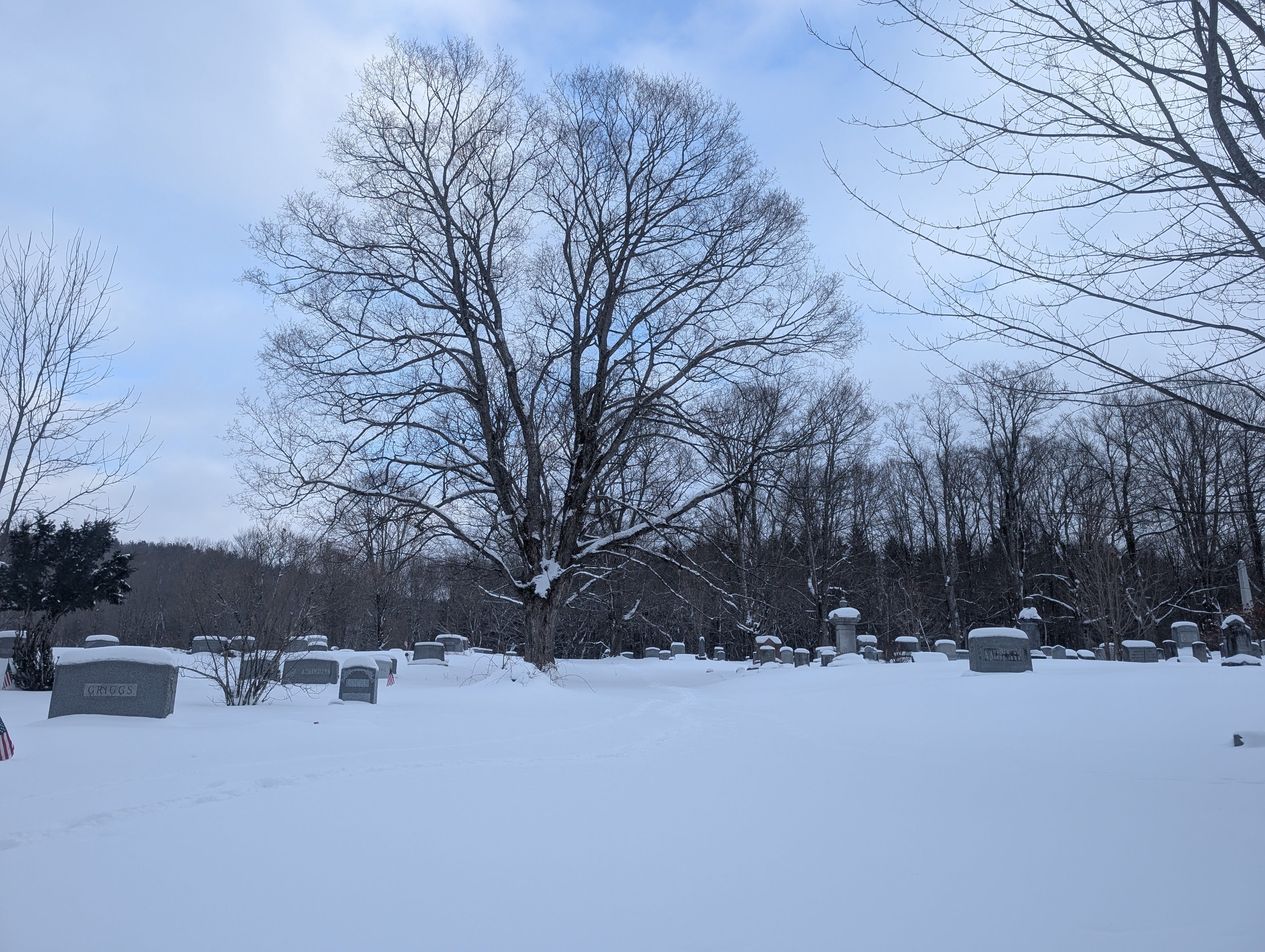
If this is too big, one thing we can do with all this is simple—pay attention. In Advent, we practiced being “watchful,” staying alert, minding the details. Because, as one of my old New Testament TA’s is fond of saying, details matter. You know they matter because you know the details of your life matter. You are not just Thing 1 with Story A from Town B. You were specifically and lovingly made in the image of God, with a story you carry, and it carried you here today to this church and this specific little town of Craftsbury. There is no church and no place and no thing that is too small for God. On the contrary, it is here, where we are small enough to be specific, where we actually can be closer to him than in the bigness of everything.
And we worship the entire all of everything of God fully by knowing the details of his love, just as the God of the cosmos knows and loves you down to every last detail. God doesn’t just love you—he died for you. He didn’t just die for you, he let humanity, his own people aligned with state power, kill him. He wasn’t just killed by them, he was humiliated, tortured, and died by one of the worst forms of execution humanity ever thought of, a cross. The specific love of the universal God is specifically like this, one that would rather let you kill him than let you hurt yourself. But there’s one more detail, well, for now: this flesh and blood human Jesus Christ, entering the world as a vulnerable baby, is made of a love that would not let death get the last word. You can know the God of the cosmos by this. For death is nothing, but the love of God is absolutely everything. Amen.