

And Jesus told them many things in parables, saying: “Listen! A sower went out to sow. And as he sowed, some seeds fell on a path, and the birds came and ate them up. Other seeds fell on rocky ground, where they did not have much soil, and they sprang up quickly, since they had no depth of soil. But when the sun rose, they were scorched, and since they had no root, they withered away. Other seeds fell among thorns, and the thorns grew up and choked them. Other seeds fell on good soil and brought forth grain, some a hundredfold, some sixty, some thirty. If you have ears, hear!”
“When anyone hears the word of the kingdom and does not understand it, the evil one comes and snatches away what is sown in the heart; this is what was sown on the path. As for what was sown on rocky ground, this is the one who hears the word and immediately receives it with joy, yet such a person has no root but endures only for a while, and when trouble or persecution arises on account of the word, that person immediately falls away. As for what was sown among thorns, this is the one who hears the word, but the cares of this age and the lure of wealth choke the word, and it yields nothing. But as for what was sown on good soil, this is the one who hears the word and understands it, who indeed bears fruit and yields in one case a hundredfold, in another sixty, and in another thirty.”
Matthew 13:3-9, 19-23
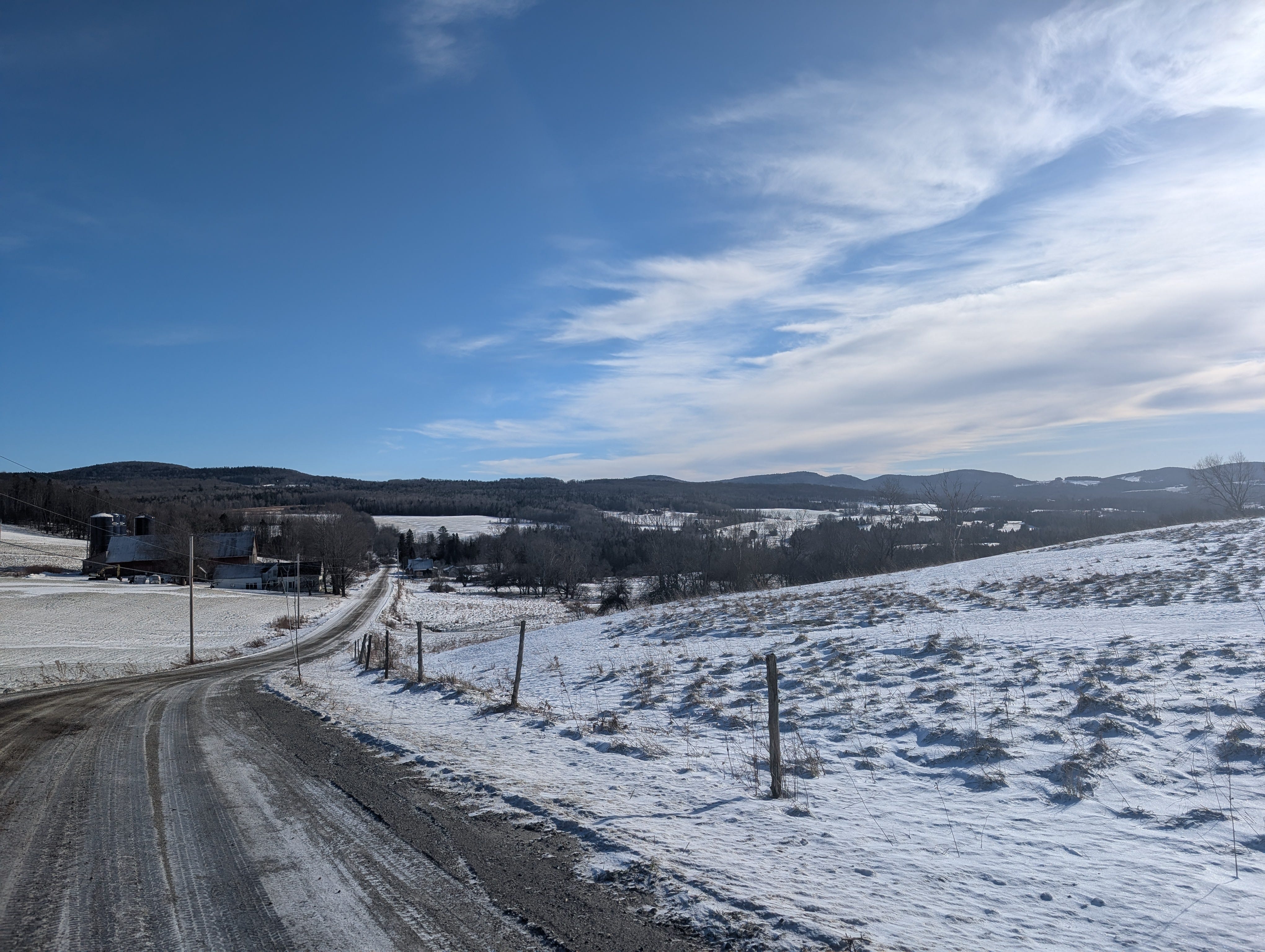
Today, on Holy Saturday, our gospel reading is not about Jesus’ death, nor rolled-away stones or angels in white—for that you’ll have to come back tomrrow. Today, rather than his death, we hear one of the great teachings from Jesus’ life, the Parable of the Sower. It’s one of those teachings of Jesus that stuck with his disciples. You can imagine on that Holy Saturday, one of them might have shared it as they traded their favorite stories and sayings from Jesus, not knowing what was ahead. If Jesus were around today, he might have started the Parable of the Sower off with, “There once was a farmer in the northern hills of Vermont…” And today we are, indeed, remembering the Parable of the Farmer; the Parable of Marvin Rowell.
I’m not here to tell you anything about this farmer that you don’t already know. If Georgette wanted one wish for today, it was one word: that it be “dignified”! And I don’t think Marvin would find it dignified for the preacher to focus too much on him in a traditional Presbyterian memorial service homily. After all, this is a farmer who did not work on Sabbaths, who loved singing in the choir and helping however he could, and who respected and loved and trusted the church enough to have his only real wish for his service be that the preacher pick the Scripture (I always said he was a wise man, wise beyond his 95 years).
So yes, I did pick the Parable of the Sower. And if I’m going to preach it faithfully, I must tell you that Marvin is not the star of this story. He’s not the sower, in fact, he’s not the farmer in his own story. Jesus tells his disciples plainly that the seed is the word of God. The only true farmer who can truly sow the Word is not you, not me, or our dear brother Marvin, but Jesus Christ.
No, in the beautiful, incredible story of God, it’s hard to believe, but spiritually speaking, Marvin wasn’t a farmer at all. He was great, rich soil. As Jesus describes, the good soil is that in which the Word took root and bore fruit. Good soil doesn’t produce just a random crop, an independent man standing firm on his own wisdom and prosperity by himself. He came from somewhere; from good soil he came and good soil he has returned. The fruit of that soil was not one great life. The fruit of the soil is all around you in this community, this wonderful, complicated, but beautiful family that Marvin was one part of, along with all the other good soil that y’all came from. This here is what it looks like when some ordinary people from Northern Vermont don’t choke the Word out with thorns or let it get scorched. This is what happens when you don’t let the Word die. And by the grace of God, the church should be and can be a field where good soil is revived by the true farmer of God.
I know it hasn’t always worked out that way. I know a bunch of you have complicated relationships with Christianity. I mean, you think I don’t? How did you think I ended up here? Because I figured out Jesus better than anyone? Because I’m so smart? No, I’m so dumb that I went years letting Christianity keep me away from Jesus. But Jesus was way more concerned about the Pharisees and religious elites giving the wrong idea of the faith with the living God they thought they were protecting, when really they were just protecting their pride. The Pharisees were keeping people from seeing that God was not on a purity project, but a gathering project, a search and rescue mission, and you don’t have to do the searching, you just have to let yourself be found.
Speaking for myself, I’m only here by the grace of God, and I mean that—I have no idea how I got here. Ten years ago I’m in Los Angeles in a drum circle on Venice Beach and the next thing I know I wake up and I’m talking to a bunch of Vermont farmers and their descendants about God. Don’t ask me how. I mean, I can tell you the story of what happened, the events that took place, but I can’t really tell you anything I did to make it happen. Over time, God just walked me back. And everything has been better since I started walking. I don’t know how he has worked or will work in your life, despite of or because of the Church. I just know all the love that’s here in this room, the love in these pews, the love in this building from generations, this is all living proof that there is more good soil from where Marvin came.
And what does Jesus say makes good soil? He “hears the Word and understands it,” which makes him “bear fruit and yield it.” (Matt 13:23). In other words, the good soil is not alone by itself. It receives living water. It bears more and more life of itself. And it knows it needs the farmer. The farmer who, as Psalm 65 tells us, “You visit the earth and water it, you greatly enrich it; the river of God is full of water; you provide the people with grain, for so you have prepared it. You water its furrows abundantly, settling its ridges, softening it with showers, and blessing its growth. You crown the year with your bounty; your wagon tracks overflow with richness. The pastures of the wilderness overflow; the hills gird themselves with joy; the meadows clothe themselves with flocks; the valleys deck themselves with grain; they shout and sing together for joy.” (Ps 65:9-13) The good soil is good because it knows God is always, always, always providing for us.
If you’re like me when I was in between smacks on the drum canvas on the beach, you might be surprised to hear some news: your life is not about you. Even your spiritual journey, your enlightenment, your self-discovery…is not about you. If you want a secret ingredient of good soil, that is it. If we were to get inside the head of bad soil—stick with me here—but if bad soil could talk, it would probably say, “I have all I need on my own. Sure, I’ve got my clumps and my clods, but ain’t nobody telling me what to do.” But good soil knows it has a greater purpose beyond itself. Good soil knows the Word when it encounters it. Good soil and a good life knows that your life is not your own. And this is so far from bad news.
Up above you all is one of the best parts of this church, and only the preacher usually gets to see it. It’s the three crosses on Calvary, the place where Jesus was crucified, an important image of this weekend. As the story goes, there were two violent robbers next to Jesus. After mocking Jesus at first, laughing at this supposed powerful man who was looking just as weak as they were, one of the men finally relents. He realizes he has nothing to live for—it’s over. The kind of mindset that becomes a murderer tends to think that you are above the law, above other people, that you can do as you will because you’re the one in charge of yourself. But here, in his last hour, he finally realizes that it’s done. His life is not in his hands as he thought. And he knows he deserves his fate, and Jesus doesn’t. So he says, “Jesus, remember me when you come into your kingdom.” And Jesus says, “Truly I tell you, today you will be with me in paradise.” (Luke 23:43)
That was it. He realized that his life was not his own. He was not in charge of his fate, but like good soil, he knew Life even when it was dying next to him. And that was all the criteria, not himself, his spiritual genius, his good or bad deeds, but Christ’s mercy and invitation. That’s all it is for any of us. You don’t have to be perfect. You don’t have to even be particularly good to be good soil. You don’t have to come knowing theology from a wheelbarrow. He just wants you to come.
Alistair Begg once talked about that thief on the cross. Imagine, Begg said, if the man had gotten to heaven and the angel said, “What are you doing here?” And the man said, “I don’t know.” “What do you mean you don’t know?” “Well cause I don’t know!” The angel, confused, says, “Excuse me, let me get my supervisor.” The angel supervisor comes, “So…are you clear on the doctrine of justification by faith?” Guy says, “Never heard of it.” On and on the tests go, until finally the angel asks, “On what basis are you here?” And he says, “The man on the middle cross said I could come.”
Beloved, the parable of the farmer isn’t about the farmer at all. It’s the farmer who knew his life wasn’t about himself. His life was about the man on the middle cross. And he says you can come. Amen.
powerful “He was great, rich soil,” “The good soil is not alone by itself,”