
The Pharisees went and plotted to entrap Jesus in what he said. So they sent their disciples to him, along with the Herodians, saying, “Teacher, we know that you are sincere, and teach the way of God in accordance with truth, and show deference to no one; for you do not regard people with partiality. Tell us, then, what you think. Is it lawful to pay taxes to the emperor, or not?” But Jesus, aware of their malice, said, “Why are you putting me to the test, you hypocrites? Show me the coin used for the tax.” And they brought him a denarius. Then he said to them, “Whose head is this, and whose title?” They answered, “The emperor’s.” Then he said to them, “Give therefore to the emperor the things that are the emperor’s, and to God the things that are God’s.” When they heard this, they were amazed; and they left him and went away.
Matthew 22:15-22

One of the many joys we’ve had in Craftsbury is living in the manse, which I only call a “manse” 50% of the time because that word confuses people. Sometimes I say “parsonage” to be less confusing, but I’m not a parson, I’m a Presbyterian minister, so it’s “manse,” (but try arguing about it without sounding pretentious). It’s also confusing when people ask whether that white house next to the church is “your house.” Sometimes I say “yes” to keep it simple, but it’s not my house, it’s the church’s house, but then again, the church is God’s house, so whose house is it anyway? I don’t know, it’s just not mine. But even though it’s not mine, I’ll be taking my stuff out of it this week. George Carlin famously called a house “a place for my stuff,” and maybe that’s what we should have called it the whole time instead of the manse, “The place for the preacher’s stuff.”
But it has really been a nice thing for us, because if you live in a manse, you know you are living by grace. I know I didn’t pay for this place. I’ve been keeping my stuff here, but it’s not mine. I have lived by the grace of this church, not only you here and now who have supported us, but also the grace and work and generosity of the saints of Craftsbury who came long before us. And they were supported by saints before them, and we were all supported by God. This is, of course, how everything is, but it has been spiritually helpful to have a place for my stuff that I don’t own, because there’s no mistaking it: this home does not belong to me; it belongs to God.
I believe only a handful of people in this room have lived in a manse before, but we’ve all held currency before. Yes, that may soon be totally antiquated, but all of us have held American money in our hands before, and maybe it’s been money that helped you buy your stuff. But when you hold it, whose money are we holding?

This is the question today Jesus is not just asking the Pharisees, he is asking us. I don’t know if we would like the answer any more than the Pharisees when he asks, “Whose face is on it? Caesar? Then give it to Caesar.” We might be willing to let Lincoln have his pennies back, but I’m sorry Jesus, Mr. Franklin doesn’t need to buy any more stuff. However, there is an irony of history that many Christian kings continued minting their faces on money, as if to say, “See, Jesus said to give us what’s ours.” Even deeply Protestant and anti-monarchic America, after much chagrin, eventually printed dead presidents.
Of course, as Matthew tells us, this showdown is all a trap. It’s a kind of “gotcha” that I hope my daughter will one day try on me, because if she’s trapping me in these questions, at least I know she still cares what I think, whether she wants to or not. Likewise, the Pharisees care about Jesus whether they want to or not. They hope they can either get him in trouble with Rome so they can arrest him, or they can get him in trouble with the crowds and weaken what they thought was the source of his power. If Jesus bluntly said, “Yes, pay your taxes,” maybe the crowds would have turned on him. In the end, Jesus got out of the trap, but eventually, they got what they wanted. Religion, Rome, and raucous crowds rarely agreed, but here they did: put him on the cross.
But remarkably, Jesus flips a trap meant for him into a trap for the powerful. As if to say, “You call yourself Lord and put yourself on money? Perfect. You’ve just put your kingdom in a box, where it belongs.” I think it’s perfect that we are reading this story during election season, because we can remember that the domain of today’s politicians is really so small, even when we try to immortalize them or they try to immortalize themselves. I’m not saying politics and money don’t matter, but they are spare change in our Father’s world.

We can laugh at Caesar and the Pharisees because we can recognize something in them that’s in all of us; we’ve all probably had a taste of “Hall Monitor Syndrome,” or at least you’ve been the banker in a game of Monopoly. We get the tiniest taste of power and inflate it with impunity. I remember in fifth grade I was placed on the crossing guard for my elementary school, the “Safety Patrol,” along with my friend Dominique, and what tiny kings in tiny kingdoms we were. When we weren’t barking out orders, we passed the time talking about that week’s WWF wrestling show, where Stone Cold and the Rock taught us more than we knew about masculine illusions of power; since we didn’t know how fake it was, we also didn’t know how real it was. And I don’t know what my daughter will be like, if she’ll be more into pro wrestling or more into tea parties with stuffed animals. But if I have to sit next to a bunny, I’m sure I’ll be ordered to give to the queen the things that belong to the queen.
But you know what’s a wonderful sign of God’s grace? That all of us in God’s kingdom are playing as tiny kings and tiny queens in our tiny realms, from as small as a tea party to as small as the Roman Empire to as small as the United States of America, and God is utterly not threatened by it. If anything, he is amused by it. I mean, do you hear Jesus in this story? This man doesn’t even have a denarius to give to Caesar. What does he think of any of our kingdoms? “You want to play dress up? Sure, play dress up. You want to be emperor so bad, sure, be emperor. That’s dress up for adults.” And if you find yourself at an emperor’s tea party, and he demands you give him back his coin, sure, give him his coin. To be sure, Jesus doesn’t think it’s cute when leaders abuse people while playing their games. He is not indifferent to our suffering or abuses of power, and he will make it clear that another bill is due that they can’t pay off with their face coins. But until then, have your tea party.
In God’s mercy, God will let us persist in the illusions of our little fiefdoms. Meanwhile, he’s entrusted to you something far more real and wonderful: his image. You are a coin that bears the image of God. You are not God, but through the flesh and the Spirit we are teeming with a life that we may hardly know what to do with. Maybe we hardly know what to do with it because we forget that it’s not ours; we belong to God. As Paul said, “Do you not know that your body is a temple of the Holy Spirit within you, which you have from God, and that you are not your own? For you were bought with a price.” (1 Cor 6:19-20) We are not gods, we’re God’s.

And this church, as much as I have so deeply loved and been honored and blessed to lead worship here for three years, this church is not mine any more than the manse, and it never was; it belongs to God. And when we go to North Carolina and buy a house, I might think it’s my house (and will be reminded every month that it’s the bank’s house). But even though I pay for it with money, Jesus is saying that spiritually, no house we could buy is really any different than the manse: deep down, it all belongs to God.
But our most prized possession, one that is really ours, that we shouldn’t want, yet we hold onto more fiercely than any other, is our pride. That’s the part of our stuff that doesn’t need a house; just shove it under the mattress of our minds. We remember the story of the widow who gives up her last coin, and pride is our last coin. Our money may have a Caesar or a president on it, but our pride is a coin that carries our self-image, the ruler of our lives. Our pride not only keeps us clinging to God’s stuff as if it’s ours, it makes us cling to our belief that we are self-justified people on our own who don’t need saving. Pride means that when we are put in a trap question, unlike Jesus, we respond based on who will serve us most. Really, the trap question they ask Jesus—“Is it lawful to pay taxes to Caesar or not”—is not really about the money or Caesar. It’s a loyalty test: who do you really belong to? Like when Joshua asks the angel, “Are you on our side or the enemy’s?” And the angel says, “Actually, I’m with God. Now take off your shoes, you’re standing on holy ground—God’s land.”
But the trap they are trying to put Jesus into is deeper and even older than testing loyalties. Maybe it’s a question they were trapping themselves into without realizing, a question that our pride loves to answer, “What kind of good person are you? What kind of righteous person are you? Are you righteous because you work for the kingdoms of this world, or righteous because you fight them?” Jesus knows that neither answer makes you righteous, and either answer puts you on the cross. You either are put on the cross by Caesar, or the crowds, or by the spiritual and moral authorities of the day, and if you’re Jesus, all at the same time.
I have mentioned it before, but I really am going to miss having the backdrop of Calvary in front of me as I preach every Sunday, where I can see Christ’s cross and two smaller ones:
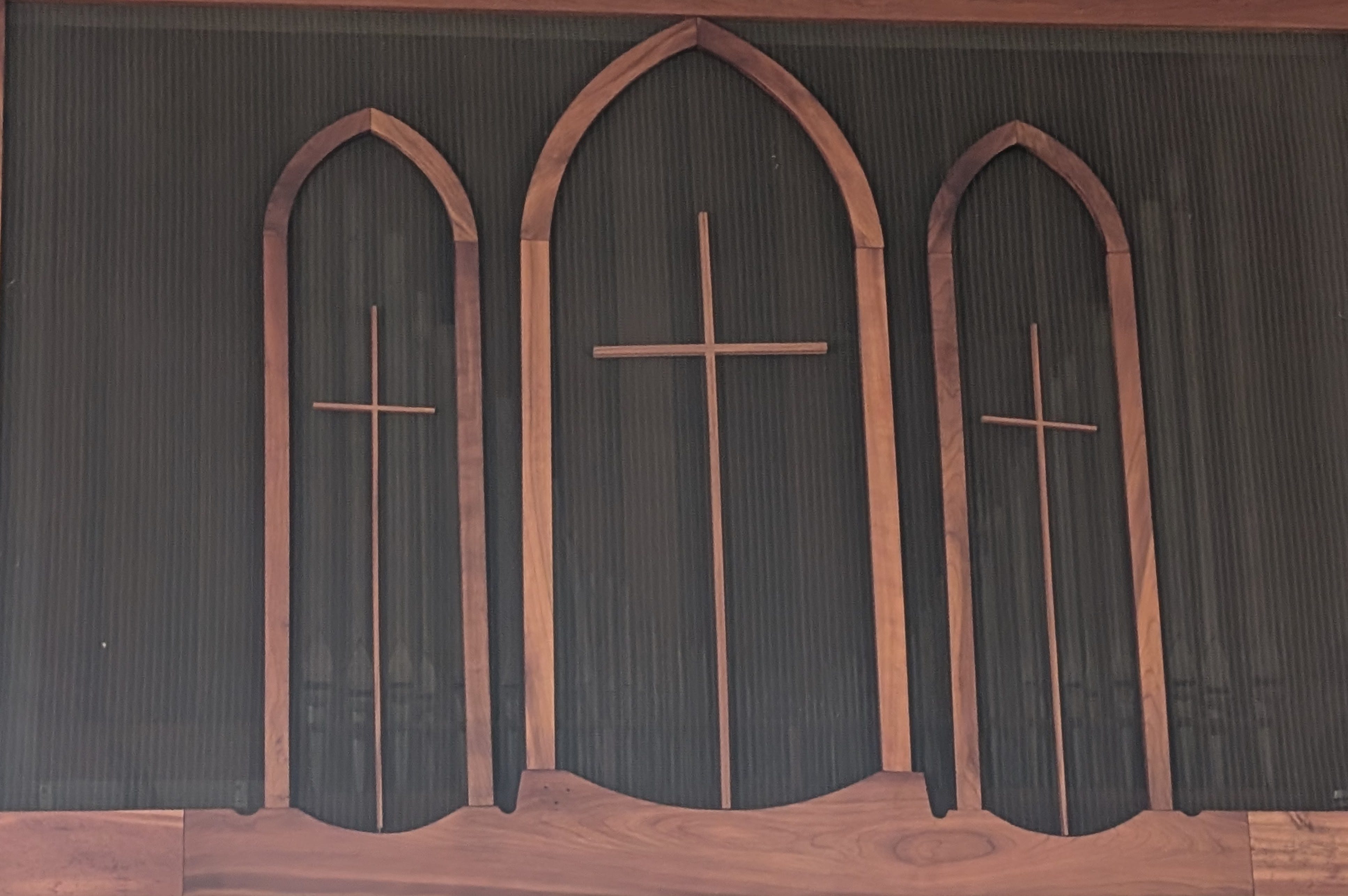
In that story, one of the thieves seems to have held onto his most prized possession all the way to the end, that pride, the one thing he didn’t have to steal. He mocks Jesus, “Save yourself, Messiah!” But the other thief, having also proven himself unrighteous, makes another choice. “Jesus, remember me.” He gives up his pride, his last coin. And Jesus says, “Today, you will be with me in paradise.” So let us take our self-innocence, our self-justification, and our self-salvation, and not give it over to Caesar, but give that to God too. “For whosoever will save his life shall lose it, and whosoever will lose his life for my sake shall find it.” (Matt 16:25)
The good news, friends, is that we can afford to lose our life because it’s not even really ours. As Niebuhr said, our truest freedom is in discovering our lack of freedom; our deepest belonging is discovering we do not belong to ourselves. When we try to hold onto the life that isn’t ours anyway—when we try to gain it by taking Caesar’s coin from him—we lose it. We gain it when we echo the deep memory of the truth that Calvin echoed from Paul: “We are not our own: let us therefore forget ourselves and all that is ours. We are God’s: let us therefore live for him and die for him. We are God’s: let his wisdom and will therefore rule all our actions. We are God’s.”
The manse isn’t mine, or yours, or anybody’s—hallelujah. Your life is not your own; it’s just a place for God’s stuff. So give to Caesar his spare change and your two cents. But give to God the last coin with your face, and give to God everything that carries his face—all your heart, all your soul, all your mind—and love your neighbor as yourself. Then you will not only enjoy everything that he has given you as a gift, but you will keep being his gift. I know you have been to me. Thank you. Amen.