

Now the Lord said to Abram, “Go from your country and your kindred and your father’s house to the land that I will show you. I will make of you a great nation, and I will bless you, and make your name great, so that you will be a blessing. I will bless those who bless you, and the one who curses you I will curse; and in you all the families of the earth shall be blessed.”
Genesis 12:1-3
And as Jesus sat at dinner in the house, many tax collectors and sinners came and were sitting with him and his disciples. When the Pharisees saw this, they said to his disciples, “Why does your teacher eat with tax collectors and sinners?” But when he heard this, he said, “Those who are well have no need of a physician, but those who are sick. Go and learn what this means, ‘I desire mercy, not sacrifice.’ For I have come to call not the righteous but sinners.”
While he was saying these things to them, suddenly a leader of the synagogue came in and knelt before him, saying, “My daughter has just died; but come and lay your hand on her, and she will live.” And Jesus got up and followed him, with his disciples. Then suddenly a woman who had been suffering from hemorrhages for twelve years came up behind him and touched the fringe of his cloak, for she said to herself, “If I only touch his cloak, I will be made well.” Jesus turned, and seeing her he said, “Take heart, daughter; your faith has made you well.” And instantly the woman was made well. When Jesus came to the leader’s house and saw the flute players and the crowd making a commotion, he said, “Go away; for the girl is not dead but sleeping.” And they laughed at him. But when the crowd had been put outside, he went in and took her by the hand, and the girl got up. And the report of this spread throughout that district.
Matthew 9:10-13, 18-26
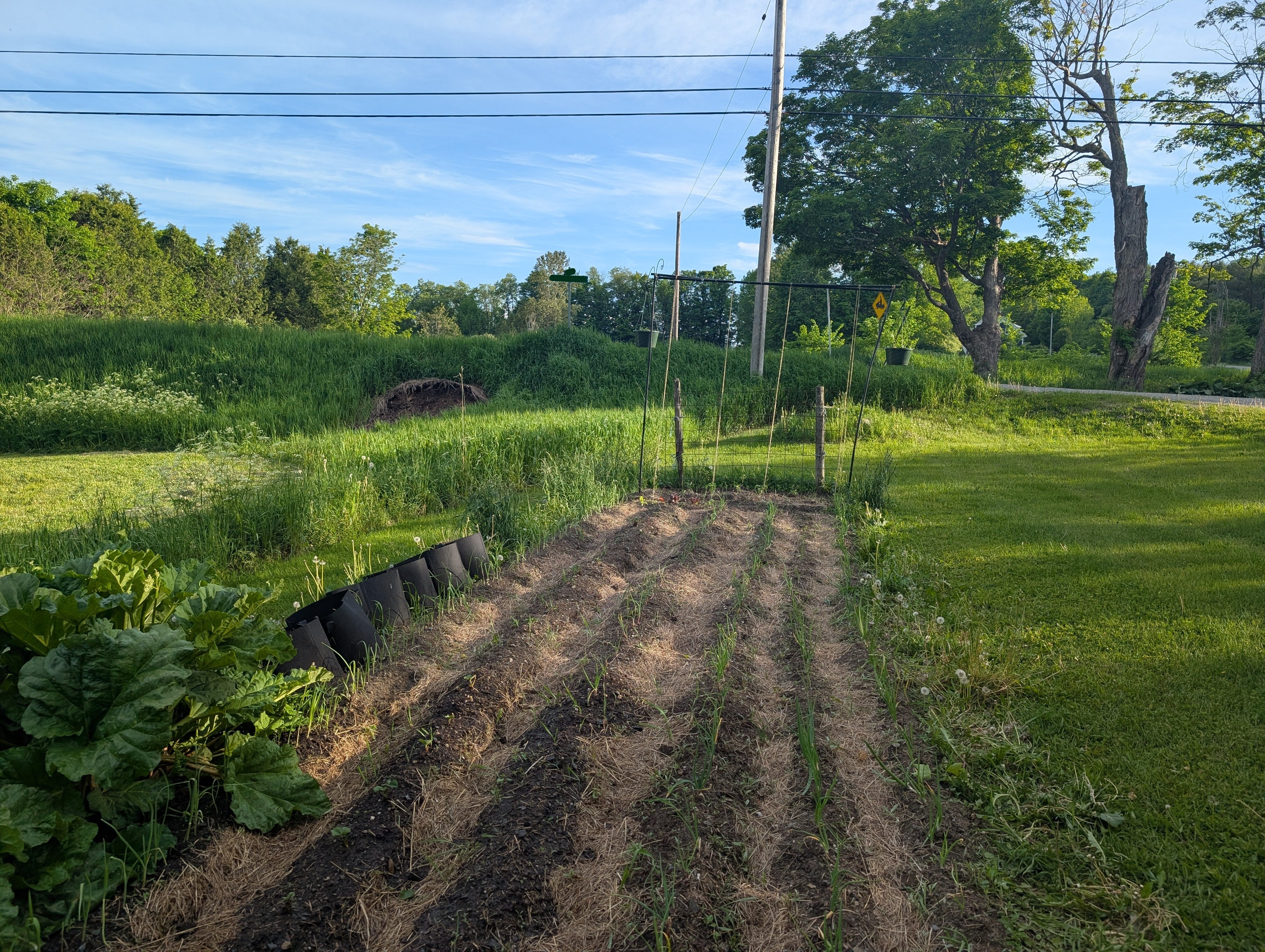
I’ve been learning about gardening this year, by which I mean my wife did all the planning and the digging and the planting and the setting up of our makeshift tomato trellis and the haying, so really it’s more accurate to say that I’ve been learning about watering. As simple as it is, I’m sure I’m not doing it completely right.
It might sound dumb, but I had never really thought about where all the water “went.” Yes, I took science classes in high school, so I have heard the basic geology of water tables and how our wells draw from the saturated waters of the ground. But it wasn’t until I was actually in the dirt each day with our $13 adjustable hose nozzle that I started thinking about the flow of water, flipping through the different settings, like “mist,” “fan,” “jet,” “center,” and (maybe the first one I should have tried) “garden.” My basic instructions were to “water it until it starts to pool,” so that’s what I do. And the first time I watered the hanging basket at head height, I let it get saturated, and the excess water flowed out the bottom of the hole, and I finally realized, “Oh, wow, if you water the dirt enough, the extra water flows out.” I will hold for your slow-clap applause break for this feat of flatlander scientific discovery.
But as I was thinking about that and our readings this week, I thought, what if God has been telling us all along that his grace works the same way? The story of God’s grace goes all the way back to the creation, which we talked about last week, where the breath of God is like a garden hose being turned on, “Let there be light!” Let the trees grow and the water flow. And the blessings keep on flowing from there. Then, of course, humanity comes along and just wants to put our finger on the spigot: Adam and Eve, Cain and Abel, on and on past Noah until humans start building a Tower of Babel to “make a name for ourselves,” which isn’t just trying to get famous, but wanting to make ourselves great—to think we can actually make ourselves on God’s level on our terms with technological intervention and get all to the way up and up and there’s nothing God’s gonna do but maybe give us a high five from heaven. But obviously humans didn’t get that high five. We didn’t make ourselves great. Our will and our sin made us build the wrong thing for the wrong reasons in the wrong way.
But God does not give up in the face of our evil. He just decides to make the nature of his grace even clearer through this almost-nobody called Abram. What we read today is basically our entire introduction to Abram, apart from listing his family members and that his father had thought about going to Canaan but got to Haran and said, “Eh, this is fine.” Abram is about as nondescript of a human as it gets. He had not done a single thing worthy of blessing, but God turns on the sprinkler and says Abram, I am going to bless you so much that you will be a blessing. Abram’s name meant “exalted father.” But the truly exalted heavenly Father said, “Abram, you are going to be different from those who want to make a name for themselves. I will make your name great.” Remember that when the Bible talks about names, it means more than just what we call them, but something deep about their nature and who they are. So God is not just saying, “Abram, I’m going to make you famous,” no, God is saying, “Abram, I’m going to make you good. I’m going to make you a man who lives up to what you are called. I will even one day change the name you are called into Abraham, ‘father of a multitude,’ because I am going to pour my blessings out so much on you that it will soak down into the roots that will grow from you.” Take it from this seasoned green thumb, that’s how water works. And that’s how grace works.
Like our dearly departed Marvin, the good farmer who was the “great soil,” Christ says we are all spiritual soil in God’s creation, just ordinary people like Abram. We get so arrogant thinking that we can grow without the water of God that is grace. The Tower of Babel is not just about technology; spiritually, it’s when we act like a big pile of dirt that thinks it can grow into a tree. But the story of Abram shows God telling us that his grace is not about us making ourselves great. It’s God making a name of us, forming us in our very being to his character, saturating us with his love and care. God pours his water on us, which has nothing to do with deserving it. As Deuteronomy tells us, “Do not say to yourself, ‘My power and the might of my own hand have gotten me this wealth.’ But remember the Lord your God, for it is he who gives you power to get wealth.” (Deut 8:17-18a)
What God also says to Abram is what he says to all of Abram’s children, which by faith, Scripture tells us, is every Christian: “You are not just to receive a blessing, you are to be a blessing.” How? As simple as being wet soil: you become a blessing by letting God’s grace flow through you. Soaked up by the blessings of his love, like water flowing down into the roots, you let the water flow on to the rest of the garden that needs it. It’s like when an artist says, “It wasn’t even me moving the paintbrush, it was just something divine flowing through me.” Live like there is an abundance of grace flowing through you, because through the Holy Spirit, it is! You are already overflowing with grace. Even in pain, even in suffering, even when our mind can’t stop telling us what we lack, when we pray and give thanks to God, we can remember this truth: we are overflowing with grace.

Now in contrast to the good soil of our garden, just a few yards away you have our driveway. It’s a mix of gravel and sand that tires have packed down over and over for years. When it rains, water will be pooled up there for days, sometimes weeks if there’s no sun and it’s chilly, because the soil is packed so tight that water cannot go through it. The water just sits there, not nourishing anything, just something for me to splash through every time I come home. Same with the little rut in Shatney Road which, no matter when I walk down it, always has a pool of water. The water can’t flow down through hard soil, and because it’s shaded, it has no sun to dry it up.
It is a great tragedy that we Christians are so often like packed in soil, that when we get the grace of God, we only let it pool on top of us. We don’t let grace sink into our dirt. It just sits there in excess. That’s exactly what the Pharisees are like, too, soil that gets wet but is so tightly packed together that the mercy and love and grace of God can’t pass through. They still feel the mercy moisten them, like the top of my driveway, but it’s not even running off the angled sides to better grass, it is just pooling up in a nasty muddy rut. Jesus got so frustrated at them because here they were, presuming to teach people about God, and they don’t even know how to let God’s grace change their own lives. And because they don’t know how to let it change their own lives and transform their hearts, they don’t know how to let the grace of God flow on to their neighbors. In effect, their goal was to be so strictly disciplined that maybe, just maybe, God would love them. Their name also meant “the separated ones,” and they sure did make that name for themselves. To be sure, one thing we get wrong with criticizing the Pharisees is thinking that growing in holiness doesn’t matter; Jesus doesn’t say that we shouldn’t be disciplined or intentional about our personal piety or that the Law didn’t matter. But Jesus points out in the Pharisees the dark side of trying to make ourselves holy to reach God’s blessings, the religious version of a Tower of Babel. Jesus is teaching us the paradox that we are called to be a blessing, which we can only do by accepting that we are not that holy. We need grace. And we need spaciousness with each other that looks like true brotherly and sisterly love: the space to make mistakes. The space to be forgiven. The space to be able to confess where we have not been as good as we know we should. The space to say you know what, we all need water, and honestly, I’m thirsty. For it is the people who know they are thirsty who are time and time again the people that Jesus seeks out.
When Jesus tells the Pharisees, “I didn’t come for the righteous, but for the sinners,” he’s saying, “I came for the dry soil, not the water that’s already wet. I came to bring life to those who need life.” And because the Pharisees are like tightly packed dirt, Jesus does what his Father did to the generations of Israelites that didn’t help the downtrodden and speaks a prophetic word. When Jesus is a prophet, he’s giving a word that un-clods the dirt like a broadfork. When Jesus is confrontational, he is usually saying that if you are not letting mercy flow, then I will work on you until my grace flows through you. So Jesus tells them, “Go and learn what this means, ‘I desire mercy, not sacrifice,’” quoting the prophet Hosea (Hos 6:6). Christ is the one who would do all the sacrificing we need. He would become the very Lamb who pours not only water, but the blood of his salvation. And so in the light of all that was done for us on the cross, no, God is not impressed with religious rituals that keep us compact, isolated, separate, and closed off. We have been blessed by grace. It’s not ours to pool up. Let it flow.
And where does grace need to flow? “Those who are well have no need of a physician, but those who are sick…I have not come to call the righteous but sinners.” The wet soil doesn’t need more water. Jesus came for the dry soil. And when we are saturated with his grace, we, his body, the Church that is supposed to be Christ in the world, must let his waters flow to the thirsty. To Jesus, his grace flows for the woman who has been ailing for 12 years and not able to enter the Temple, who must have felt so, so distant from God; for the sick child, who they thought was dead; for those who are even doing wrong because they don’t really know God, and are living in ways that you know are wrong, but that’s exactly the kind of soil that needs water.
If the kingdom of God is revealed in all creation, it’s a blessing that God entrusted each of us with our own community gardens to steward together. We are Pharisees when we act like these are just for ourselves, as if the kingdom of God is just our private walled garden. Because gardens are not meant to live for themselves, but to nourish life that begets more life. So though we are sinners, gardens give us a divinely healthy, carefully curated, flourishing, stewarded place of life-giving-life taste of God’s kingdom. Gardens of plants are the same as gardens of people. People need the right conditions to grow and thrive, too: enough space to grow on their own into who God made them to be, some sunlight, and the water of grace that, yes, only God can provide. But Christian love can be as simple as living like a $13 adjustable hose, spreading God’s grace to wherever the soil is dry. All Christians are called to water our community gardens as Christ poured and pours and pours his love on us.
I love the first line of our Doxology, “Praise God from whom all blessings flow.” Don’t pack yourselves in so tight that your blessings become a muddy pool. Let your blessings flow. You are saturated with grace. So let his blessings flow. Don’t be a puddle! Let his blessings flow. Amen.
For more on this week’s readings:
