

After the sabbath, as the first day of the week was dawning, Mary Magdalene and the other Mary went to see the tomb. And suddenly there was a great earthquake; for an angel of the Lord, descending from heaven, came and rolled back the stone and sat on it. His appearance was like lightning, and his clothing white as snow. For fear of him the guards shook and became like dead men. But the angel said to the women, “Do not be afraid; I know that you are looking for Jesus who was crucified. He is not here; for he has been raised, as he said. Come, see the place where he lay. Then go quickly and tell his disciples, ‘He has been raised from the dead, and indeed he is going ahead of you to Galilee; there you will see him.’ This is my message for you.” So they left the tomb quickly with fear and great joy, and ran to tell his disciples. Suddenly Jesus met them and said, “Greetings!” And they came to him, took hold of his feet, and worshiped him. Then Jesus said to them, “Do not be afraid; go and tell my brothers to go to Galilee; there they will see me.”
Matthew 28:1-10
Maybe it’s hard to believe, but this was a morning of low expectations. They were so low that almost nobody was there. The wisest religious leaders of their time weren’t there. The elders and scribes weren’t there. Jesus’ twelve closest male disciples weren’t there, no gurus, no influencers, nobody who would have had a podcast in their society was there. If you were trying to make up a story to make the halls of power care about your Messiah, nobody was there that could have helped make the story go viral. The only people who showed up were women who loved Jesus.
We don’t know why they were there; they probably didn’t know why they were there. Maybe you don’t know why you’re here. Something in them that morning just needed to see the tomb. Maybe, at best, a small voice in them was wondering, well, he did raise Lazarus. He did mention a resurrection. He did say something about his body being raised up. But….no, that is insane. That cannot happen. That does not happen. Tombs are for dead men and spices, and it’s already got a dead man, so let’s bring some spices.
And then it got weird. Everything was shaking as if the foundation of the universe had been broken apart. Some dude in a blazing white-hot tunic freaked out the guards. They pass out. And this angel in white didn’t have a ton to say—he was not super into explaining himself—but he said one thing they could not forget: “Fear not. He’s not here. He is risen. Tell your friends. You will see him in Galilee.” Immediately they are overcome with fear and joy, awe and wonder, and then, before they get two steps down the road, there is Jesus, really him, alive. “Fear not! Tell my friends. You will see me in Galilee.”
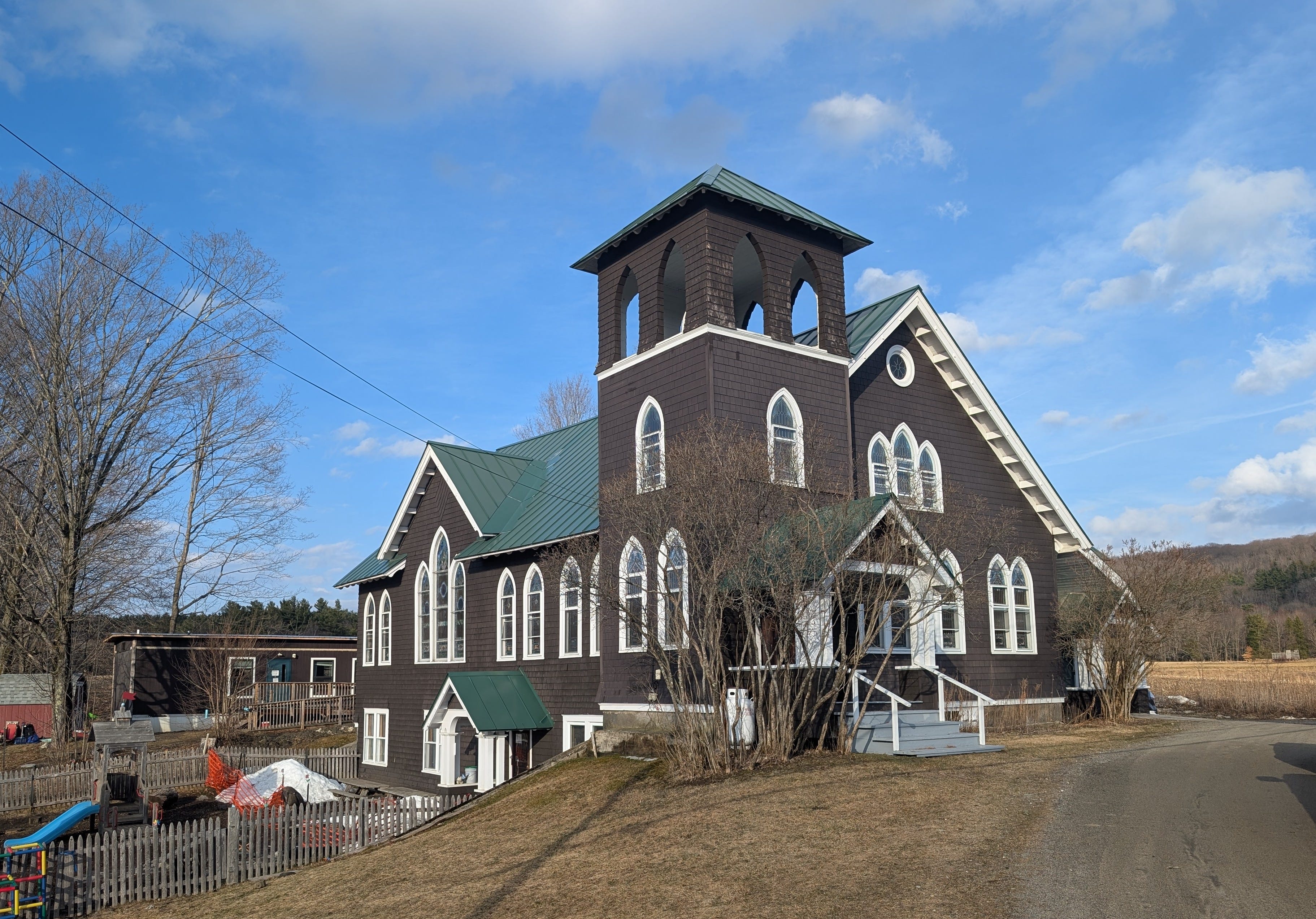
Now hold up. Galilee. Why Galilee? What is that? Is that just where the party is? It wasn’t just where this unlikely Messiah called home. It was the place of no place. The hinterlands. Really, we here in the Northeast Kingdom are probably the Galilee for our own state and country. What would be our Galilee in Craftsbury, maybe Wolcott—the place you go through to get from home to the rest of the world.
But if Jesus walked out of the tomb on Whetstone Brook Road, he’s not going to the Genny, to the Academy, or to the Outdoor Center, he’s telling us, “Meet me in the place the world forgets about.” Jesus is saying, “This resurrection is not for us here in our bubble. This gift of life is for everybody. This is not just about us. This is a world reclamation project. I am bringing everybody home.”
When Jesus says two seconds after having risen, “I’m going ahead of you to Galilee,” he is saying he is going back to the outsiders to bring this message to them—not to Jerusalem and the religious people who just got the state to execute him. But God is going to weave in the people you forgot about into God’s story. Because all who suffer, all who are oppressed, all who are put under the heel, everybody’s pain, everybody’s sin and everybody’s suffering can all be woven together into God’s story.
He didn’t go to the people who thought they were already found and didn’t need saving. Those people didn’t choose him. We didn’t choose him. We still don’t choose him when we mistreat a neighbor, when we ignore the Galilees of our time, the forgotten places, the places and people we think nothing holy can come from. We still don’t choose him anytime we wield the threat of death for power. We still don’t choose him when we think in “us and them,” which never goes out of fashion.
This resurrection morning is not just about going to heaven when your body dies. To be sure, he rose for you and your one life. But when he rose up out of that grave, God was not rising up out of the grave for one life or one people. He wasn’t rising out of the grave for just part of humanity. I mean, if you’re going to upend the very fabric of the physical laws of the universe, you’re not going to do that for just one people. He chooses all people. The whole reason God comes through one people Israel is because the story of Israel was never meant to be for just itself. God’s people are supposed to live for the world, to be a priestly nation, and to help other people understand God. We’re still called to that, now as the priesthood of all believers. There is no “us and them,” we’re us. He chose himself for the cross instead of us and our death, and he chooses all of us in the new life.
He is choosing you despite whatever you’ve done and whatever hell and death you face. The resurrection didn’t come when it was already light, but when it was dark, and there is no darkness his resurrection cannot work in. I’ve seen it, and I know you’ve seen it.
There’s a Vermont band many of us know called Phish. They’ve been my favorite band since I was 16, and the first thing I ever learned about Vermont was that Phish was from there (make of that what you will). Trey Anastasio was the lead guitarist, a musical genius, one of the best guitarists who has ever played the instrument. Phish had become a giant cultural phenomenon, as big as Ben and Jerry’s, but eventually, it collapsed under the weight of drug addiction, ego, and darkness. In 2004, after their last concert ended in a muddy disaster in Coventry, the band was over, done, dead.
A few years go by, and the guitarist Trey is arrested in upstate New York on drug charges. Later, he would say the officer saved his life that night. But he still had a long road to walk. He goes to drug court, gets convicted, and ends up going from being a rockstar to brushing toilets at the New York state fairgrounds. He starts his recovery, and if you’ve ever gone through it as I have, one of the worst things is not knowing what it means to be just normally alive. For Trey, if you listened to him in this period, it almost sounds like he had forgotten how to play sober, this instrument that he had mastered, but seemingly couldn’t access it without numbing himself, and all his fans could hear it. Any musician could understand what prison that would be.
So while he is still serving his sentence, Trey couldn’t leave New York state, but his friend Dave Matthews happened to be playing in Saratoga Springs, New York. What happened is capture in one of my favorite YouTube videos (from the Ice Age of YouTube) on an old, choppy, grainy video from this 2007 concert. It shows the moment where Trey’s friend invites him to play a song called “Lie In Our Graves.” It’s the first time Trey had been on stage since getting sober. And when his fans watch the start of it, knowing what Trey was capable of as a player at the peak of his powers, it’s almost heartbreaking. He is barely expressing himself on the instrument. He doesn’t look confident, and I wonder if he felt embarrassed at how many people knew what he was going through.
But his friends on stage with him trust him. They let him breathe. And he keeps playing. And it’s like you can see him getting his chops back in real time, the light coming back into his eyes. He starts to believe in himself, and the crowd starts believing in him, and he feels the crowd believe in him. It’s like seeing a man come back to life before your eyes. The jam builds and builds into this triumphant roar before quieting back into stillness. The video cuts out, but anyone who knows the song knows the words that come next: “I can’t believe that we would lie in our graves wondering if we had spent our living days well. I can’t believe that we would lie in our graves dreaming of things that we might have been.”
In the end, Trey got his band back. Twenty years of sobriety and more than 600 shows later (which I’ve seen about 5% of, I did the math), he’s opened a rehab facility, Divided Sky in Ludlow, and inspired tons of people like myself to get and stay sober and to know that resurrection is not naive, but real. He did not lie in his grave. By the grace of God’s resurrection power, he wove in the pain of the soul that was left for dead into a more beautiful life lived for others than he could ever have imagined in the darkness.
But let me be clear, too, that while this story shows what resurrection power looks like as common grace for any of us, I believe there is something weirder going on. Don’t believe me, believe the women who loved Jesus. Believe his friends who would eventually find him in Galilee, with the outsiders, bringing good news to the poor, to proclaim freedom for the prisoners and recovery of sight for the blind, to set the oppressed free. And that good news is not just that God loves you. It’s not just that seasons come and go and hope springs eternal. The good news is that death is dead.
Jesus told his friend Lazarus what he tells all of us: get up, for in me you will not lie in that grave, and you will not wonder if you lived well. For the one who chose you said, “I am the resurrection and the life.” He is for all of us. Praise be to God. Alleluia! Amen.
Ah, a Phish reference for every season 😂 A beautiful Easter sermon.