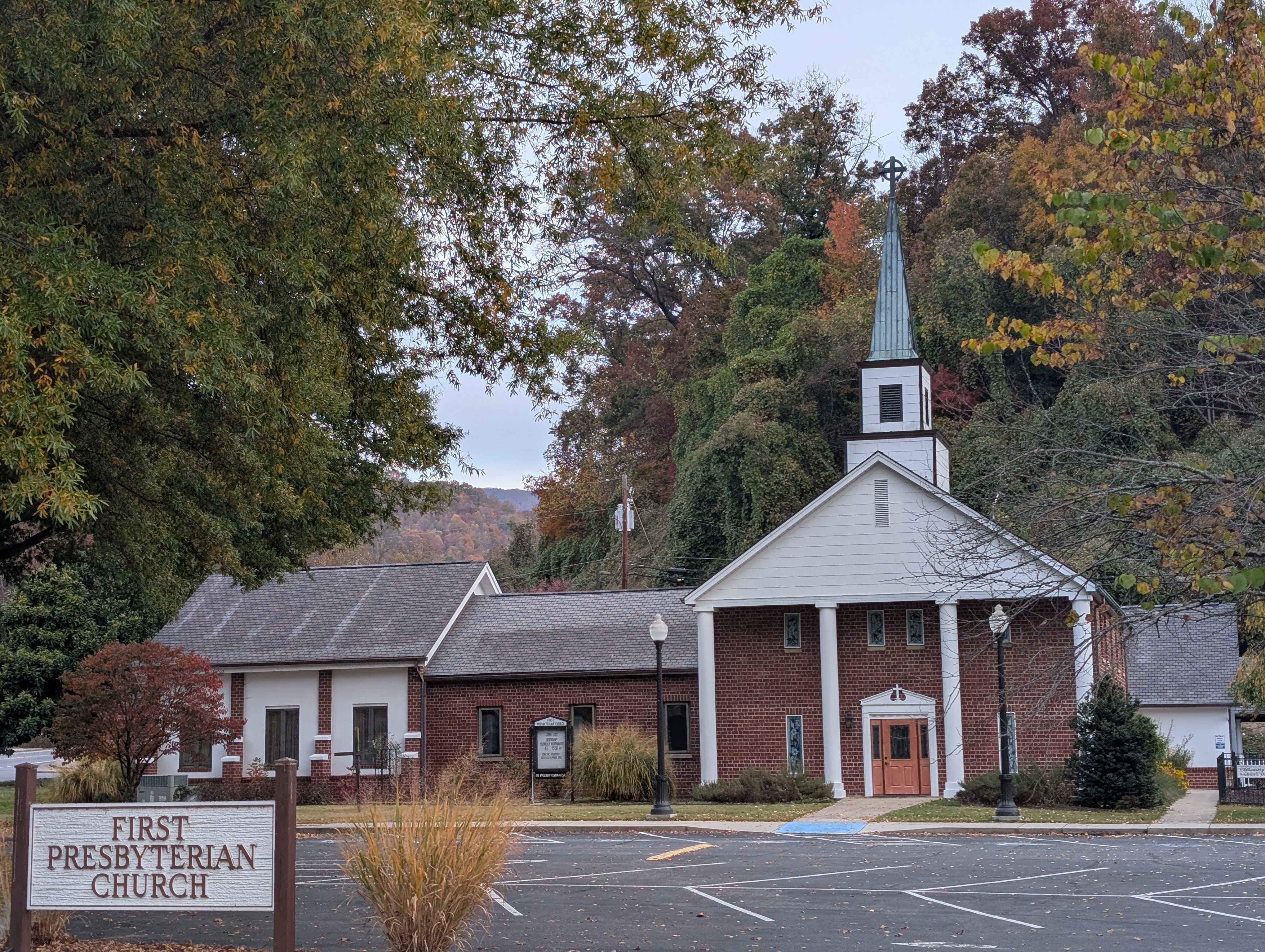
Note: this is the sermon preached at my first Sunday as pastor of First Presbyterian Church of Sylva, NC

Joshua gathered all the tribes of Israel to Shechem, and summoned the elders, the heads, the judges, and the officers of Israel; and they presented themselves before God. And Joshua said to all the people, “Thus says the Lord, the God of Israel: Long ago your ancestors—Terah and his sons Abraham and Nahor—lived beyond the Euphrates and served other gods. Then I took your father Abraham from beyond the River and led him through all the land of Canaan and made his offspring many.
“Now therefore revere the Lord, and serve him in sincerity and in faithfulness; put away the gods that your ancestors served beyond the River and in Egypt, and serve the Lord. Now if you are unwilling to serve the Lord, choose this day whom you will serve, whether the gods your ancestors served in the region beyond the River or the gods of the Amorites in whose land you are living; but as for me and my household, we will serve the Lord.”
Then the people answered, “Far be it from us that we should forsake the Lord to serve other gods; for it is the Lord our God who brought us and our ancestors up from the land of Egypt, out of the house of slavery, and who did those great signs in our sight. He protected us along all the way that we went, and among all the peoples through whom we passed; and the Lord drove out before us all the peoples, the Amorites who lived in the land. Therefore we also will serve the Lord, for he is our God.”
But Joshua said to the people, “You cannot serve the Lord, for he is a holy God. He is a jealous God; he will not forgive your transgressions or your sins. If you forsake the Lord and serve foreign gods, then he will turn and do you harm, and consume you, after having done you good.” And the people said to Joshua, “No, we will serve the Lord!” Then Joshua said to the people, “You are witnesses against yourselves that you have chosen the Lord, to serve him.” And they said, “We are witnesses.” He said, “Then put away the foreign gods that are among you, and incline your hearts to the Lord, the God of Israel.” The people said to Joshua, “The Lord our God we will serve, and him we will obey.” So Joshua made a covenant with the people that day, and made statutes and ordinances for them at Shechem.
Joshua 24:1-3a, 14-25

Good morning. I am so grateful to be here in these early days of getting to know each other. Although the sermon is not really for the purpose of getting to know me; when I was learning about FPC Sylva, I was inspired to hear what your former long-time pastor Bill Serjak used to say: “If you look around you, you will find fault with everyone, especially the pastor, since he is most visible. But our job is not to point you to ourselves, but to Jesus Christ, with whom man has yet to find fault.” I love that. And our readings this morning, brought to us by the Revised Common Lectionary, do both point to Jesus Christ.
I will be focusing more on our Joshua reading today, and as I was reading it for this Sunday, I thought there is at least one thing you can learn about me: even though I moved from North Carolina fifteen years ago and have lived a bunch of different places, Carolina has always been close to my heart. When I first moved to Los Angeles, I even got my first tattoo, those three Latin words of our state motto, esse quam videri, “to be rather than to seem.” It felt important to me, not only to stay tied to my roots, but also to commit myself to authenticity, to “being real,” being my own person. At a time of flux and change and figuring out what I believed, it was a pledge of allegiance to be my true self. (By the way, some general advice: never explain a tattoo if you don’t have to.)
It was important to me because when I lost the faith of my preacher’s kid upbringing, I thought that I, myself, was all I had left to count on. Some of you may have gone through or be in similar crises of your faith and identity as I did: you grow up religious, go to college (or just go to the internet), and your world stops making sense. Religion starts feeling man-made, artificial; perhaps you think it’s un-intellectual, dishonest, unreal. You figure you can’t trust much of anything except your experiences and the things that tangibly, reliably, immediately serve you. So that’s where your loyalties shift to. And why wouldn’t they?
As a spiritual seeker, I would live by a phrase you may have heard that captures this M.O. of modern society: “Let go of the things that no longer serve you.” And there may be practical wisdom in that; sometimes we can be unduly attracted and attached to things that actively harm us, and we should all want to be free of those things. But also notice the subtle (or not-so-subtle) language there that makes this idea, “Let go of the things that don’t serve you,” popular. The defining criterion is whether you are served. It’s not whether the “thing” you are to let go of—who is often not a thing, but a person—is someone you are committed to, some people you have a responsibility for, or a truth that is unpopular, or a hard job that nobody wants to do but needs to be done…the criteria for something being in your life is, “Does it serve me?”
And so like many, that was my ethos. I could swear allegiance to esse quam videri, “keeping it real,” because authenticity served me. I could be an artist and serve art because making art served me (just not monetarily). I could pick up and let go of relationships, pick up and let go of personas, friend groups, subcultures, whatever didn’t serve me. Being authentic and sincere meant defining myself for myself. I suppose the most circular, airtight logic at the bottom is that I could be faithful to myself because I serve myself. But one of the practical and spiritual jokes of it is that if you only serve yourself, you never truly, fully get served. It’s also one of the loneliest ways to live in the known universe.
So is that really how we are to live? Are we really only to serve “the things” that serve us? And do those “things” actually serve us?
Our Scripture readings today blow up these questions. In fact, our Joshua reading ends with a very clearly different answer after God lays out a choice, echoed by a Bob Dylan song: “You’re gonna serve somebody, so who will it be?” But with God putting the words in his mouth, Joshua doesn’t just say out of the blue, “You better serve God.” No, before God asks for any allegiance, God speaks through Joshua to help the people remember. Before asking for any loyalty, obedience, or service, God first asks us to just remember all the graces of God.
Of course, “remember” is one of the most common, repeated, and vital commands throughout Scripture. What’s funny about biblical memory is that it’s not only about remembering things we’ve personally experienced. It’s like how we remember our birthday despite not actually remembering our first birthday. Or like this Wednesday, we will remember our Veterans, some of whom we know, but we will also remember men and women we’ve never met and wars we weren’t even alive for.
This is also what remembering is like in the Bible: not recalling something you have experienced, putting yourself at the center of your life, but bringing the works, goodness, and grace of God to the top of your mind and center of your heart. We “remember the Sabbath” not like “oh shoot, I forgot it was Sunday,” but bring the promise of God’s rest and grace back to the top of our minds so much that it prompts us to respond in faith. Every Sunday, we worship as a form of remembering who God is, where God is, how God is, remembering him back to the center of our beings. Jesus tells us at the table, “Do this in remembrance of me,” internalizing deep in your being that he is truly with you and for you, always, even when you forget it.
And so before asking for any service, God tells Joshua to pass along this message. Remember all the ways that he has led us, guided us, and given himself to us, from Abraham to Egypt to the wilderness to the Jordan to this place, this moment, but remember, Israel, “I gave you a land on which you had not labored and towns that you had not built, and you live in them; you eat the fruit of vineyards and oliveyards that you did not plant.” (Josh 24:13) As if God’s saying, “Put it on your heart, you are not here because you served yourself. You live by grace. And I’d do it all over for you again. Because I am your God, and you are my people.”
If all this history feels a little abstract, take a moment to remember what God has done in your own life. Remember how far God has brought you to be here, at this moment. Remember the people God has put in your life, the chains he has broken, the way out he showed you when you thought there was no way. And don’t just recall it. Bring it into your heart. It might feel overwhelming and impossible to tell it all, so just let it sit in your heart.
Only after Israel has fully remembered God back in their heart does Joshua respond with a loving challenge to his people, “Now, therefore, revere the Lord and serve him in sincerity and in faithfulness…choose this day whom you will serve.” (24:14a, 15a) You are free to serve the false gods of your ancestors or the false gods of your contemporaries. “But as for me and my house, we will serve the Lord.” (Joshua 24:15) Some of us might have that on a cross-stitch in our home.
After a back and forth, we learn the people still have the false gods of their ancestors in their homes while they commit to serving God. They haven’t put them away yet, and maybe we haven’t either. Maybe they’re even sitting next to the cross-stitch. But in Christ, by grace, we can let go of false gods that don’t actually serve us, because God has served us in his love far better; as Jesus said, “the Son of Man did not come to be served, but to serve.” (Matt 20:28) The false gods are false not because they don’t have power, but because they don’t actually serve you. They destroy you. Jesus has already served you more amazingly than anyone or anything ever could, God giving his very life for you on the cross so he might destroy death and dwell in you. Joshua’s Hebrew name was Yeshua, who led Israel into a promised physical land through violence, but now there is a new Joshua, a man with the same Hebrew name Yeshua, Jesus. In his promised land, we no longer study war, but conquer evil through self-giving love. We follow Jesus not by letting go of what doesn’t serve us, but by letting go of what doesn’t serve others; as he said, “I give you a new commandment: love one another. As I have loved you, so you must love one another. By this everyone will know that you are my disciples, if you love one another.” (John 13:34-35)
And I have already personally seen how you serve each other here; not just in the moving help, not just in the generous hospitality and food we’re gonna eat, not just in the conscientious Earth Care programs, but even more simply in your care for each other. I can testify that there is a wonderful web of prayers going on here, and not just prayers, actions: checking in, touching base, giving rides, bringing meals. One of the best parts of getting to live next to the church right now is seeing just how busy y’all are at the business of love.
But I don’t have to know you well to know that this love isn’t always perfect or easy. Christ alone perfected the love that nourishes us all and challenges us all, a love more honest, more clear-thinking, and more patient than we can ever be with ourselves or each other when our sin gets the best of us. The best I can do any week is be a professional reminder to keep looking at Jesus.
In Jesus, authenticity is no longer about defining ourselves for ourselves. To be our most authentic, fullest expression of our individual souls in Christ, we are called, as God tells Joshua, to “serve him in sincerity” (24:14). Serve him for real. And serve him by serving each other for real; esse quam videri. Let us not be a people that just seems like we serve God, let us be a people that really serves God. Yes, we will fail at this. We will be unfaithful. But God never will be. And he will keep dealing with sin, not by destroying us in battle, but by redeeming us in his love.
But truthfully, and maybe heretically, I don’t know if esse quam videri is even my favorite state motto anymore. In Vermont, we lived about a half hour from the Canadian border. When you would drive across the border into Quebec, the signs immediately change to French, a language that is a proud part of their identity and uniqueness, a way to say, “We are not going to be erased into the rest of the world.” And as you drive into Canada, you see all the license plates change from Vermont green plates to white Quebec plates. On each one is their motto: “Je me souviens.” “I remember.” Three words in French, two words in English, capturing everything about their collective struggles for their homeland, their language, their identity, their way of life, all there: “Je me souviens.” “I remember.”
Like the people of Quebec, God’s people are defined by remembering. We remember. Not our earthly memory in our bodies and minds that come and go, but remembering in our soul who God is, and remembering that no matter what happens or what anyone says, you are his. And when we remember what God has done, and we trust what God will do, deep in our bones, that’s all the oil you need to burn through the darkest night.
It was a crazy world when I was away from North Carolina, and it will continue to be a crazy world. We can’t control other people. We can’t know what the future holds. Whatever hardships, whatever joys, whatever the noise, whatever the weather, as for me and my house, we will serve the Lord. And by the grace of God, as the people of God, we won’t just seem to remember. We will remember. Amen.