Note to readers: Last week, I shared with my congregation the bittersweet news that I have accepted a call to serve a church in Sylva, North Carolina, to be near my family as we start our own. We are grateful, but also grieving, as we leave our wonderful community in Craftsbury. I will continue to share my sermons here on Indwelling.
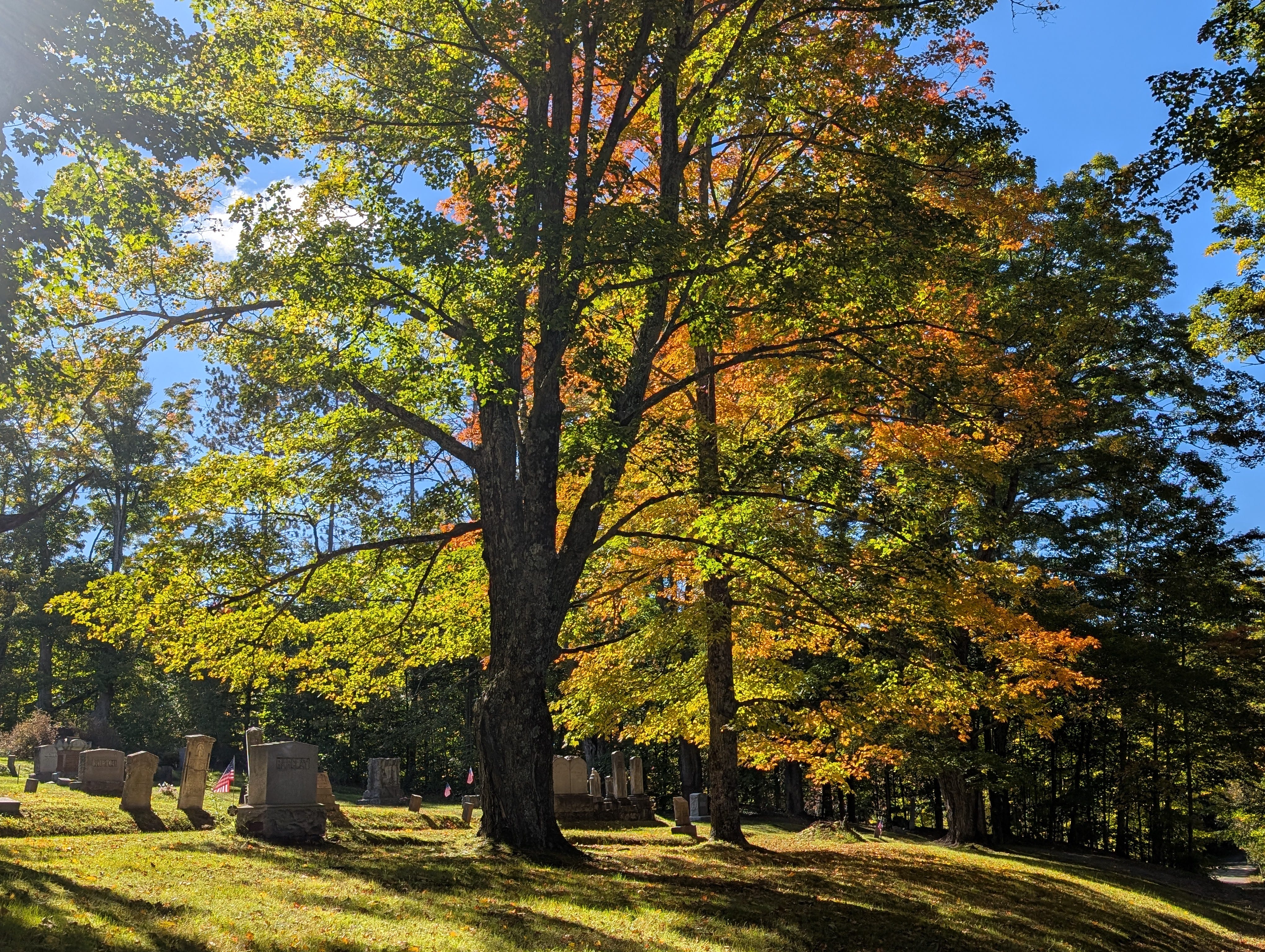
Jonah said, “And now, O Lord, please take my life from me, for it is better for me to die than to live.” And the Lord said, “Is it right for you to be angry?” Then Jonah went out of the city and sat down east of the city, and made a booth for himself there. He sat under it in the shade, waiting to see what would become of the city.
The Lord God appointed a bush, and made it come up over Jonah, to give shade over his head, to save him from his discomfort; so Jonah was very happy about the bush. But when dawn came up the next day, God appointed a worm that attacked the bush, so that it withered. When the sun rose, God prepared a sultry east wind, and the sun beat down on the head of Jonah so that he was faint and asked that he might die. He said, “It is better for me to die than to live.”
But God said to Jonah, “Is it right for you to be angry about the bush?” And he said, “Yes, angry enough to die.” Then the Lord said, “You are concerned about the bush, for which you did not labor and which you did not grow; it came into being in a night and perished in a night. And should I not be concerned about Nineveh, that great city, in which there are more than a hundred and twenty thousand persons who do not know their right hand from their left, and also many animals?”
Jonah 4:3-11
To me, living is Christ and dying is gain. If I am to live in the flesh, that means fruitful labor for me; and I do not know which I prefer. I am hard pressed between the two: my desire is to depart and be with Christ, for that is far better; but to remain in the flesh is more necessary for you. Since I am convinced of this, I know that I will remain and continue with all of you for your progress and joy in faith, so that I may share abundantly in your boasting in Christ Jesus when I come to you again.
Only, live your life in a manner worthy of the gospel of Christ, so that, whether I come and see you or am absent and hear about you, I will know that you are standing firm in one spirit, striving side by side with one mind for the faith of the gospel, and are in no way intimidated by your opponents. For them this is evidence of their destruction, but of your salvation. And this is God’s doing. For he has graciously granted you the privilege not only of believing in Christ, but of suffering for him as well-- since you are having the same struggle that you saw I had and now hear that I still have.
Philippians 1:21-30
Am I not allowed to do what I choose with what belongs to me? Or are you envious because I am generous?
Matthew 20:15

Today, Scripture gives us a tale of two prisoners.
First, meet Jonah. No, he’s not in jail. Jonah is just a free man who feels like his life is a prison. We are so used to stories with character development; Joseph Campbell’s “hero’s journey” mapped how most timeless stories have characters who leave home, go on a journey, encounter strife, and come back changed. But Jonah isn’t a hero—he’s one of us. He goes on a physical journey, but doesn’t go on a spiritual journey. He begins as a man who hates to suffer, and he ends still a man who hates to suffer.
Just to refresh: Jonah hears God’s call, knows answering it could be pretty painful, so he gets on a boat. The storm comes, he realizes he can’t actually avoid suffering, and he gets a brief moment of moral clarity—“Well, since it’s my fault, let me sacrifice myself for these men, and they’ll be saved. I’ll be dead, but hey, I won’t be suffering anymore.” He goes overboard, ends up in the whale, gives thanks to God for saving him, God gets him back on land and sends him out again. He obeys God this time—probably to avoid another whale detour—and preaches in Nineveh, and Nineveh repents beyond his wildest dreams. But has he repented? Is he transformed? Nope! Even the grace God gives his enemies is yet one more wound for Jonah, one more thing to suffer in this prison of life. As Jesus would say in his parable of the generous landowner, “Am I not allowed to do what I choose with what belongs to me? Or are you envious because I am generous?” Jonah would say, “Yes, actually. I’d rather you not be generous to them. Be nice to me.”
See, Jonah is still one of us. “Take my life, God, I can’t stand it anymore!” “I wish I were dead!” Three times he wishes for death, a man who would rather be dead than alive.
But notice again when Jonah says, “Take my life, God.” And notice how God messes with him with giving him shade, and taking it away, almost like God is saying, “Take your life? I already have your life. You already belong to me. Sorry, not sorry. Oh, and by the way, the people you hate belong to me too, and so do all the animals in creation. Am I not allowed to do what I choose with what belongs to me?”
Jonah’s now fully aware he’s not God. He can’t stop his own suffering. He hasn’t changed. This life, his body, all of it a prison of suffering. And because of that, look at how he acts even when given life and freedom. Look how he acts when someone else is given life and freedom! He can’t stand it. He’s a prisoner of his own mind.
But there’s another prisoner in our readings today. We don’t know where—Ephesus, Rome, somewhere—but Paul is in jail. But because he sees his life as free in Christ, he is totally free in prison, where living is still Christ.
What can a free man do when he can’t leave a room? Will he feel sorry for himself? Will he hate his jailers? Paul says, “Okay, well, I may be in jail, but I can still write letters. So I’m going to write some of the most beautiful letters that will teach my friends about God. I may be in jail, but I still have a mouth, so I can share the gospel to the jailers.” He says, “For to me, living is Christ and dying is gain. …my desire is to depart and be with Christ, for that is far better, but to remain in the flesh is more necessary for you. …[so] I will remain and continue with all of you for your progress and joy in faith.” So even if he’s in prison, even if he’s beaten, even if he’s brought to death, who cares? God has a use for him here, so here he will be.
One man, Jonah, thinks he’s in prison despite being free. Another man is free despite being in prison. Paul cries, “I wish I was dead!” Paul says with a huge grin, “I wish I was dead! But living is still Christ.”
So which prisoner are we? I think if we look around the world, and look at ourselves, most people, most of the time, can relate more to Jonah. We feel defined by what we can’t do and can’t control because what we can’t do and can’t control makes us suffer. We can’t afford what we want, and we can’t afford to give everyone what they need. We can’t control society, and the times get weird. We can’t control aging, and our bodies suffer. Sometimes we may impose false limits on ourselves, limiting beliefs, when actually we do have more capacity for change than we realize, but most of our limits are not self-imposed. Most of our limits we have a hard time accepting.
So maybe life does feel like a prison to you. Maybe you feel severely limited by what you can offer God. Maybe your mind feels like a place you can’t escape, and maybe your body doesn’t allow you to do what you wish you could. Maybe you feel like Jonah more than half the time: “Jesus, just hit the eject button already.”
I don’t know about you, but the times I wished I was dead in a Jonah way were not the hardest circumstances of my life. I was a starving artist in LA, feeling like I could do anything, and the future was unlimited. In LA there were 1000 things you could do on any given night (only to sometimes do none of them). I lived for myself because I thought I belonged to myself, and whether I succeeded or failed, it would be because of some failure within me. And every day I suffered because every day was a reminder that I wasn’t fulfilling my dreams and doing unlimited things. The circumstances, though, were not really that bad—it was all almost entirely a prison of my own making, suffering at the hands of what I thought I was owed, just like one of those grumbling workers in the vineyard who thinks he deserves more.
But what was strange was how I didn’t feel like Jonah when there were much harder circumstances in my life, when I was in seminary, faced with ethical dilemmas that would alter my future. I often felt alone, overwhelmed, isolated, and for a couple years, I was stuck there. But there was a purpose. It was just as I had started actually taking my discipleship seriously, hearing words from those old confessions, like the start of the Heidelberg Catechism that says, “I am not my own, but belong—body and soul, in life and in death—to my faithful Savior, Jesus Christ,” and it meant something to me. It meant I belonged to one who had a higher, more perfect standard of embracing suffering for the sake of the world than I would ever achieve myself. It meant I was never alone. Every day, as a Christian, we have to face our limits—we’re not Jesus, and we never will be. We can’t forgive our enemies perfectly. We don’t help all our neighbors when we should. We’ll never be a perfectly finished jar of clay. And yet we still do the best we can in the direction we know God is calling us and trust that God’s glory is all the more glorious in our limited imperfections.
Because we follow a God who loves limits. A God who took on a human form, as Paul will go on to say in Philippians 2, a God who decided to become an utterly fragile and limited human. God made himself a human who could be arrested and thrown in jail and judged by other humans and crucified. And he would go through all of it. He didn’t avoid any of these limits. He embraced them all for the sake of love on the cross, where the glory of God was never more visible than in a body broken for you.
We want to belong fully to ourselves, to owe no one anything, to do whatever is right in our own eyes to avoid suffering. If we believe we belong to ourselves, then every limit on what we can do is another bar in that prison. Every responsibility is an imposition. But we do not belong to ourselves, because Jesus did not belong to himself—he is a God who says, “I belong to you. And you belong to me.” As Paul would say to his other friends, “We do not live to ourselves, and we do not die to ourselves. If we live, we live to the Lord, and if we die, we die to the Lord; so then, whether we live or whether we die, we are the Lord’s.” (Rom 14:8)
And if we belong to Christ, we belong to each other. And if we belong to each other, our main goal in life is not to avoid suffering. Instead, God calls us to do as Jesus did: embrace suffering for each other. Embrace our limits—the limits of our bodies, the limits of our minds, the limits of our gifts, the limits of where God has put us, the limits of our times…God has transformed it all on the cross. And now, by faith, living is Christ.
Living in Jesus Christ opens up a whole world of options within the world as it is, even if it’s not as it should be. Instead of asking to not be in prison, wishing we were dead already, living in Jesus Christ lets us ask, “What can a free man do in my prison? If I’m in the prison of my body, what can my body actually do?” Living in Christ lets us say, “If I can write, I’ll write to someone who needs it. If I can talk, I’ll talk to someone who needs it. If I can pray, I’ll pray for someone who needs it. If I can feel, I’ll hurt with someone who needs it. If I can encourage, I’ll encourage someone who needs it. And if anyone else feels like they’re in a cell all by themselves, I can let them know they are not alone, and I’ll be their cellmate too.” Thanks be to God, you already do that. Every day for three years, I have seen what this wonderful community is capable of. And it brings God glory.
If we have grown old, and tired, and hurting, and can’t do half of what we used to, there is something in this moment and in your limitations that God is yearning to use to show you and the world his glory. If you are in prison, do what only a prisoner can do. If you can only do a handful of things, do them to the fullest and devote them to God. Don’t ask God to take your life. He already has it. Just ask him, “How do you want to use me today?”
In Christ, we are no longer simply waiting for heaven. Because Jesus Christ is risen, alive and well in the Holy Spirit, so are we. Here, today. You wish you were dead? Brother, sister, you are in Christ now. Not just when we die, but in the life that is not your own. Dying will be gain. But today, living is Christ. Amen.